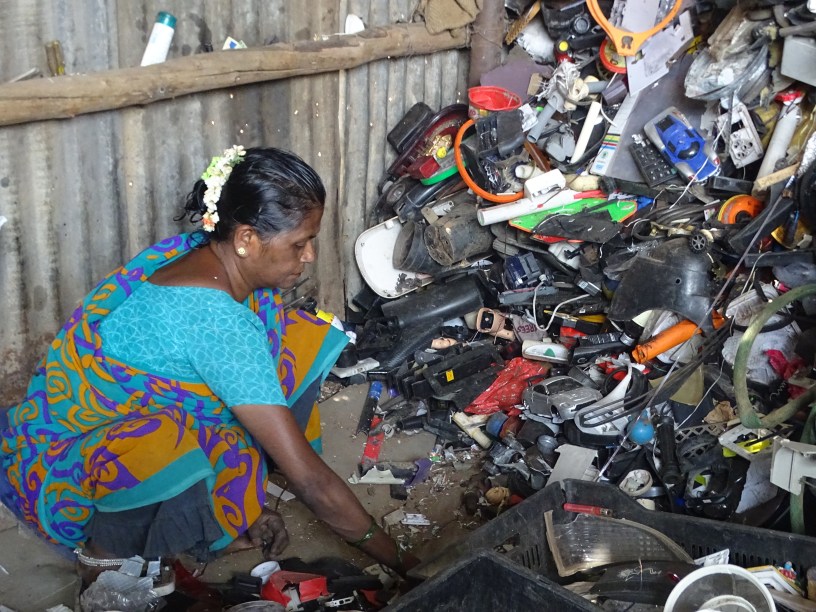
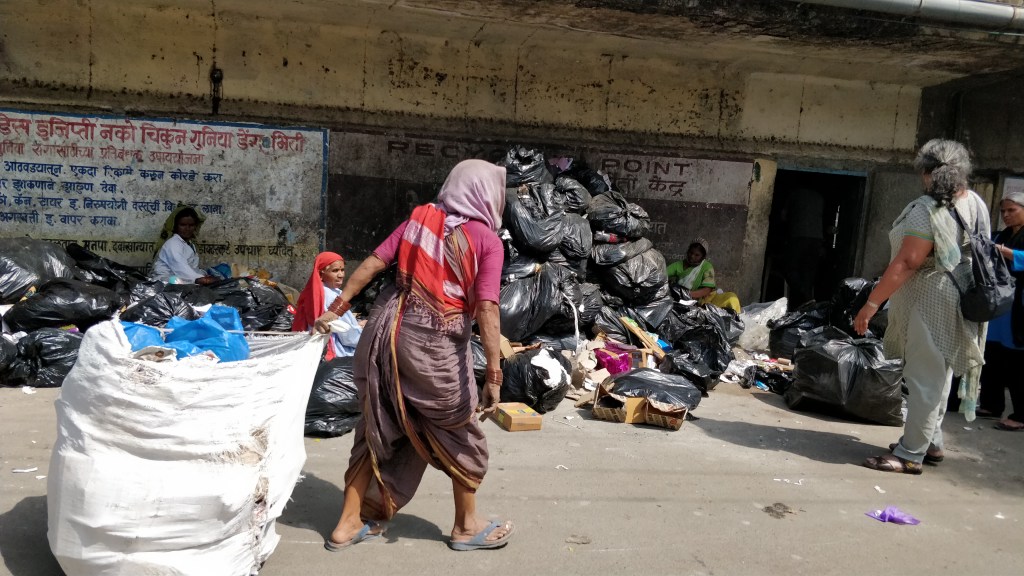
I was randomly browsing through my LinkedIn when I came across a post on a seminar advocating for inclusion of waste workers in the city’s formal waste management system by a reputed institution. The seminar had its heart in the right place, but what made me cringe was the term used to describe the people in waste. ‘Rag pickers’. They simply got the language wrong. What’s wrong? you may ask: we all use the term ‘rag pickers’ to describe someone who makes their living out of waste – and after all they do collect some rags. Even the dictionary would define ‘rag picker’ as a person who scavenges rags and other discards for a living.
Taking the definition apart, Mansoor Ghouse, a waste micro entrepreneur in Bengaluru, questions, “What comes to your mind when you use the word ‘ragpicker’ or ‘scavenger’, to describe the act of collecting or gathering? And here, I am asking you to describe the visual image that comes to your mind. Be honest, would the image identify the person, or would it evoke pity, disgust or sympathy, bordering on savagery, hatred, anger, or dirtiness?” Nalini Shekar, cofounder & executive director, Hasiru Dala, adds, “The term ‘scavenger’ in India has a different meaning, it is often associated with the practice of clearing night soil and it is banned now. Internationally though, the term is often used when talking about waste picking. ”
Fluidity and constantly changing language
In 2008, the term ‘waste picker’ was adopted at the First World Conference of Waste Pickers, in Bogota, Colombia. It was critical to arrive at terminology that clearly demarcated this category of workers from others and articulated a collective identity of workers, with similar aspirations across the world. The local definition for countries might vary. In India, official terminology uses ‘waste picker’, but in unguarded conversation ‘rag picker’ is the most commonly heard term. “Lay persons, academics, officials and even journalists hear us say ‘waste picker’ but repeat back ‘rag picker’, because the language is so ingrained. And the hard truth is that these terms perpetuate caste based stigma and discrimination”, says Rohini Malur, a communication specialist.
“I feel bad when people use the words ‘rag pickers’ or ‘chapar’, as it is sensational and it immediately creates a strong visual, and the word ‘chapar’ is given to mean ‘a person carrying stolen goods on the shoulder’. 15 years after the adoption [of the term ‘waste picker’], it is sad that the old words still rule. But I also realise that things will not change overnight. It is years of social conditioning, but things change gradually and then the word seeps into our everyday vocabulary,” says Mansoor.
Language can create powerful stereotypes, and one of the most important issues here is not just what term is used to describe a community, but how we treat them because of the term being used. And so ‘rag picker’ becomes a way to market poverty and marginalisation in the popular media and in social impact investment, removing both accuracy and the dignity we must afford all labour.
Taylor Cass Talbott, Project Officer, WIEGO, says,”The thing about language is that it changes over time; so much is constantly re-evaluated. In one sense, this makes it easier to know through language who is following the work of waste pickers, and whether they care enough to use the ‘accepted’ language.” “I’m more inclined to cringe at terms that try to over-sanitise our work. Sometimes people describe waste picking practices like canning or dumpster diving as ‘gleaning,’ which feels like an inaccurate sanitization of what we are usually talking about. Gleaning has a cleaner image because it traditionally describes recovering food waste for consumption,” says Taylor. But that cleaner image is a way for us to avoid the reality of waste work – we find it difficult to find that balance between derogation and patronisation. In the end, our language must boil down to R.E.S.P.E.C.T. The key here is to ask how a person chooses to identify, rather than using outdated terminology or imposing our own beliefs. The experience is personal – we are speaking of actual people, doing actual work.
Need for an empowering respectful language
Lakshmi Narayan, co-founder of SWaCH Cooperative in Pune, says “It is important to reclaim language. However, we need to understand that terminology evolves, as it should, with changing politics, aspirations and agency. In 1993, Kagad, Kach, Patra Kashtakari Panchayat, (Paper, Glass, Metal Workers Association), was how waste pickers in Pune, chose to define themselves, while counterparts in Latin America, adopted Recicladors and Cartoneras, depending on the contexts they operated within. However, critical to any term, is affirmation and respect for their individual and collective identity, taking into account history, lived experience and pride. So, while the umbrella definition for waste workers will imply all workers who live of or depend directly on waste as a livelihood, and will include all those working in a formal set-up (municipality), hybrid system (example Dry waste collection Centers) and informal set up across the entire recycling value chain (recyclers, scrap dealers/traders, aggregators, processors etc.), how does one ensure visibility for the diverse workforce? The key here is self- determination and representation. Waste picking as a work is unique, so it is important to let the community claim their identity and no doubt the landscape for waste pickers has changed a lot.
“The process of determining appropriate global terminology is complicated by the differing Solid Waste Management scenarios and the place of the informal waste workers at the bottom of the pyramid therein. Aspirationally – and justifiably – recycler, environmentalist and other such terms have been adopted, but they make it difficult to delineate the roles of waste pickers, scrap traders, reprocessors, conscious citizens and activists. People making a living from waste in informal settings reclaim their agency, autonomy and personhood, in ways going far beyond just their appellations, and often reflecting their aspirations and ideals.”, says Lakshmi
“When I pick waste or sort waste, I do it with pride. Pride, because I know the value of the material that people call waste. There is an element of skill involved. We know that there are so many different categories of waste. In my years, as a waste picker and now a home based waste sorter, I am confident of at least 75 varied categories. There is much more, given the complexities and I should be recognised for that,” says Salma, a home-based waste sorter in Nayandahalli, Bengaluru.
The language of mutual respect – with an empowered workforce and communities living in dignity – can only exist when we listen to the voice of the “informal”. But as I conclude this piece, I hear the strong call for the word “reclaimers”, as none of the members of the community think of the material as waste, but as a resource.
A checklist
A person’s identity is so closely linked to the terms we use to describe them, and so here’s a quick checklist that one can follow:
Make a list of all the slangs and outdated, offensive words: In India, there are many local terminologies used, apart from the English words ragpicker or scavenger. Check if you are using caste-based occupation tags to describe a person. For example, the use of the word ‘chapar’ not only dehumanises the person, but further contributes to discrimination, mistreatment, and oppression.
Re examine stereotypes that our culture promotes: It is important to use affirmative language, and move away from objectifying. Language is no doubt a powerful tool that also shapes attitudes. Question, if the terminologies used are empathetic or kind.
Understand the preference of individuals: The question will always remain – Person-first language or identity-first language? For example People who work in waste, or waste pickers/waste workers? ( In person-first, occupation is no longer the primary defining characteristic.)
Language Guide
People centred language
- People who work in and with waste: A people centred language focussing on people who work in waste. In this the emphasis is on the people first.
- People who trade in waste: Implies people who make their living by trading waste at various different levels and includes people who run neighbourhood scrap shops, or aggregators and waste traders
- People who collect hair as a resource: Implies people who make their living by collecting and selling hair that is often discarded
Identity based language
- Waste pickers/Reclaimers: The term is used to describe a collective of people working with and in waste to make a living. And here the emphasis is on identity first, to describe a community. There are different types of waste pickers/reclaimers – people who collect from streets, bins and landfills
- Waste sorters: The term is used to describe a collective of people who make their living by sorting out material that is discarded and collected for further reuse or recycling
- Hair pickers: The term is used to describe a collective of people who make their living by collecting, and sorting hair from either streets or household in exchange for items usually kitchen utensils or other plastic items such as hair accessories
- Itinerant Buyers: The term itinerant means travelling more place to place and a itinerant buyer is one who travels from place to place, usually in a fixed route in a given locality collecting high value recyclables such as newspapers, cardboards or plastics in exchange for payment or barter
- Scrap Traders: The term is used to describe a community of people who make their living by trading waste at various different levels – neighbourhood scrap shops to aggregators and large waste traders
- Waste Aggregators: The term is used to describe a community of people who are in the business of waste aggregation
- Waste Processors: The term is used to describe a community of people who are in the business of processing waste and includes a range of activities including washing, grinding, dismantling, refurbishing and palletisation
 Waste Frames