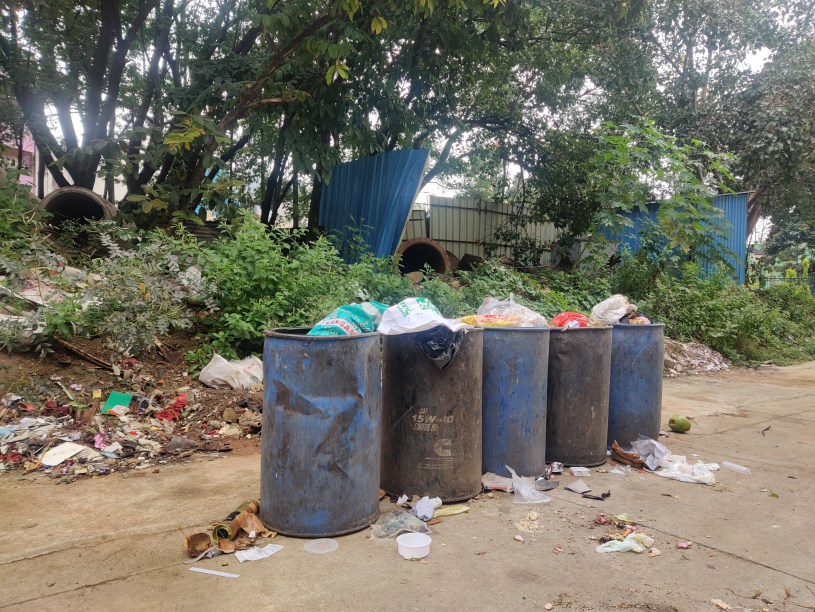
The Ministry of Environment, Forest and Climate Change (MoEF&CC), Government of India, has notified the new Solid Waste Management (SWM) Rules, 2026, which will come into force on April 1, 2026. The new rules signal a renewed effort to strengthen waste governance in the country, and they aim to close long-standing implementation gaps while aligning waste management more closely with environmental and economic priorities.
The Intent of the SWM Rules 2026 and Its Applicability
The intent of the new rules is to promote circular-economy initiatives and environmentally sound waste management, although these terms remain undefined. One can only infer from the definition of environmentally sound management of waste, from the Hazardous and Other Wastes (Management and Transboundary Movement) Rules, 2016, which defines it as taking all steps required to ensure that the hazardous and other wastes are managed in a manner which shall protect health and the environment against the adverse effects which may result from such waste;
Although the new rules define “waste hierarchy” as “a priority order for managing solid waste, emphasising prevention, reduction, reuse, recycling, recovery, and disposal, with prevention being the most preferred and disposal at the landfill the least preferred option”, the operationalisation of prevention and reduction remains less explicit in the rules. And it remains to be seen if the Ministry of Housing and Urban Affairs and the Central Pollution Control Board, with whom the responsibility of implementing circular economy initiatives across all solid waste components and the value chain, make good use of the provisions
In terms of applicability, the Rules extend across urban and rural local bodies, industrial areas, special economic zones, railways, airports, ports, defence establishments, and all categories of waste generators: domestic, institutional, and commercial. This universal applicability significantly expands the regulatory net. However, it also raises a practical question: Does universal coverage come with universal capacity?
Mandate for Four-Stream Segregation and Separate Collection of Sanitary Waste
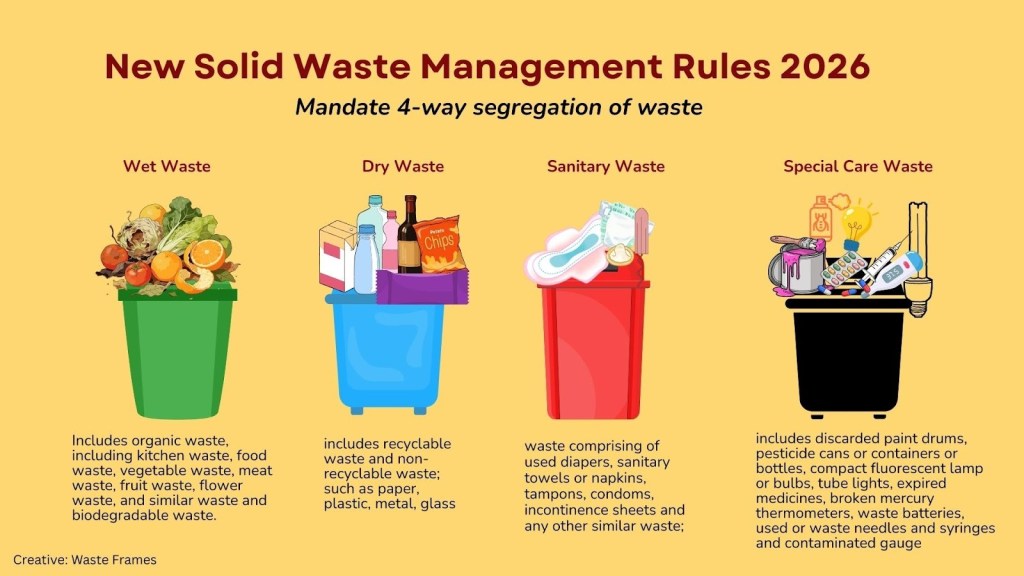
Finally, the composition of the city’s waste has been given considerable regulatory importance. For the first time since the municipal solid waste rules were introduced in 2000, a structured four-way segregation of waste has been mandated. The four distinct categories are wet waste, dry waste, sanitary waste, and special care waste. These streams must be stored separately and handed over to authorised waste pickers or collectors. Sanitary waste must be securely wrapped in the pouches provided by the manufacturers or brand owners. In the absence of these pouches, the waste should be wrapped in suitable wrapping material as instructed by the local bodies or authorities. While the new rules represent a significant and welcome improvement over the previous rules, the effectiveness of this mandate will depend on clear, consistent communication and enforcement mechanisms, as well as continuous monitoring by local bodies.
Other Waste Streams Requiring Special Attention
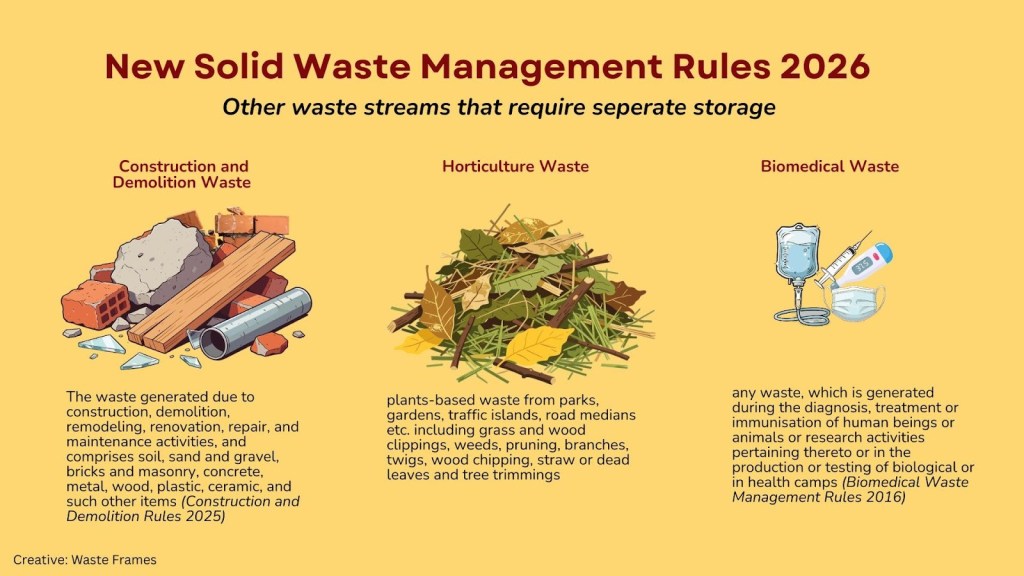
The Rules also reiterate the need to separate Construction and Demolition (C&D) Waste, horticulture waste, and biomedical waste for storage and disposal in accordance with the local body’s directions. Note: While C & D waste and Biomedical Waste are governed by separate regulatory frameworks, their explicit mention underscores the need to prevent mixing with municipal solid waste
In addition, the rules retain the previous provisions of the 2016 rules for event organisers and state that no gathering of more than 100 persons at an unlicensed venue can take place without prior intimation to the local body at least three working days in advance. Organisers are required to ensure segregation at source and hand over segregated waste to authorised collectors. However, what remains to be seen is whether the local bodies address the persistent problem of post-event waste accumulation and uncontrolled dumping. It is also important to note that there is an SOP for zero-waste events (Official functions/ Weddings/ Social or religious functions) already in place by the Swachh Bharat Mission- Urban
Bulk Waste Generators: Expanded Accountability
While the obligations relating to segregation, separate storage, and handover of waste apply to all waste generators, the 2026 Rules introduce a significantly more structured compliance framework for Bulk Waste Generators (BWGs). The rules define BWGs as any large residential complexes, institutions, commercial establishments, hotels, markets, and other entities generating waste if they satisfy at least one of the following criterion; (i) buildings with floor area of 20,000 sq.m. or above; or (ii) water consumption of 40000 litres per day; or (iii) solid waste generation of 100 kg per day.
All BWGs must now register on a centralised online portal. All new BWGs will have to set up and operate a wet waste processing facility of adequate capacity, including horticulture waste, whereas existing BWGs who are unable to do so can apply for exemption from the local body and can instead procure Extended Bulk Waste Generator Responsibility (EBWGR) Certificates from the local body.
Certificates will be generated exclusively by the local body and calculated solely on the basis of the quantity of waste collected, transported, and sent to registered processors. For wet and horticulture waste, certificates can be issued only after the authorised facility uploads confirmation of the quantity received and processed. All transactions are to be digitally recorded. The issued certificates remain valid for three years. In addition, all BWGs must submit annual returns by 30th June each year. Any non-compliance will attract environmental compensation.
On the surface, the provisions aim to create a traceable compliance loop; however, in practice, there are key unresolved operational issues which must be addressed.
- The question of inventory: First, we know that cities currently lack reliable inventories of Bulk Waste Generators. A previous self-reporting attempt through BGnet in Bengaluru by the erstwhile BBMP failed to take off. In 2023, CSE’s study also noted that while the Swachh Bharat Mission (Urban) dashboard reflects city-level BWG numbers, these are widely acknowledged to be underestimates. There is no national inventory that captures the number of BWGs, the volume of waste they generate, or the amount processed on-site.
The 2026 rules address this need and mandate that all local bodies identify BWGs through a detailed survey and update the list on the portal by 1st April each year; they must also be geotagged. The question is, how will this be realistically done in dense mixed-use urban areas? Will periodic waste audits be mandated? If so, how will they be conducted, or will we continue to rely on self-declaration?
- Verification of onsite facilities: The second issue is that the rules allow BWGs to process wet waste on-site or, alternatively, procure certificates. In the present form, the framework appears to rely heavily on portal reporting and operator uploads. So, what mechanisms will confirm that on-site processing is functional? Will local bodies conduct periodic physical inspections? Will there be third-party verification of processing capacity and operational performance?
- The Volume-Based Formula and Measurement Risk: The Rules prescribe a straightforward formula: EBWGR Certificates (kg) = Quantity of solid waste collected, transported and sent to registered processors by the local body (kg). In this formula, compliance is defined as the volume of waste moved through the municipal system. There is an underlying presumption that accurate measurement will occur at all stages: collection, transportation, and processing.
In reality, each of these requires reliable weighing, documentation and oversight. What safeguards will ensure that quantities recorded at these stages are consistent and verifiable? How will discrepancies be detected? While the Rules mandate annual audits of local body reports by State Pollution Control Boards or registered environmental auditors, the scope and depth of such audits will be critical. Will they reconcile reported quantities across the collection, transport and processing stages? Will they include physical verification and random sampling? Or will they remain document-based reviews of portal entries?
The formula also raises a related question regarding dry waste. The rules mandate segregation, recognise waste pickers, and state that segregated waste must be handed over to authorised waste pickers or waste collectors as per the directions of the local authorities. Now, in this system, does the volume-driven mechanism inadvertently privilege the local bodies over decentralised systems? The integration of waste pickers into informal and semi-formal recycling systems within this accounting framework remains unclear.
- Financial Incentives and Institutional Safeguards: The EBWGR mechanism introduces a new financial dimension into an existing operational obligation. So, while the cost of the certificate to be charged will be finalised by the CPCB guidelines, which will develop the same in consultation with the Ministry of Housing and Urban Affairs (MoHUA) and the Department of Drinking Water and Sanitation (DDWD), the local body will issue certificates and collect the costs. Following that, they will share the proceeds with concessionaires and regulatory authorities.
This raises several serious concerns, as conflict of interest is evident throughout the process: If certificate issuance becomes a predictable revenue stream, how will the system guard against incentives that prioritise certificate generation over decentralised processing? What institutional checks will ensure transparency in pricing, revenue sharing, and reporting? How will discrepancies, or double-counting, be identified and corrected? How will the mechanism remain a regulatory instrument rather than become a marketplace compliance?
Waste Management in Hilly and Island Areas
The 2026 rules largely retain the provisions for hilly areas from the 2016 rules. It does, however, extend its scope and introduces additional layers of responsibility. The core structure remains the same: landfill construction on hills is to be avoided; transfer stations are to be established; suitable land in the plains within 25 kilometres is to be identified for sanitary landfills; and, where such land is unavailable, regional landfill arrangements are to be explored. Decentralised waste processing facilities are to be set up on hills, with step-garden systems suggested for optimal space utilisation.
However, the 2026 Rules expand the geographical scope to explicitly include island areas. This is a notable shift. Islands present distinct logistical and ecological challenges, including limited land availability, reliance on inter-island transport, and heightened vulnerability to marine pollution. The new provision addresses these concerns by mandating designated waste collection points in island villages and placing explicit responsibilities on fishermen, boat operators, and tourism operators to prevent littering at sea or along the coast.
The treatment of tourism-related waste management is much needed. While the 2016 Rules permitted local bodies to levy solid waste management charges at entry points and required them to prohibit littering by tourists, the 2026 Rules go further by allowing local authorities to regulate visitor numbers in accordance with their waste handling capacity. This, at least in principle, introduces a link between carrying capacity and environmental governance.
The communication obligation has also been retained and remains significant. Local bodies are required to convey the provisions of the solid waste management by-laws to tourists at town entry points, through hotels and guest houses, and via visible hoardings at tourist destinations. While this is good on paper, this cannot be limited to hoardings alone. How can this be institutionalised and practised by everyone – residents and tourists?
Given that, over the last 10 years, hilly and mountain regions have continued to suffer from poor waste management, the more pressing question is whether these expanded responsibilities will be accompanied by region-specific planning, financial support, and sustained monitoring, particularly in areas where ecological vulnerability and administrative capacity do not align. Also Read: How can India move towards more sustainable waste management in tourist cities?
The 2026 framework is definitely comprehensive on paper. Whether it transforms waste governance in practice will depend on administrative discipline, financial transparency, and the everyday mechanics of implementation. I conclude with more questions: Will colour-coded segregation, green, blue, red, black, be uniformly adopted and clearly communicated across jurisdictions? Will hills and islands receive tailored implementation support? Will tourists, residents, and sanitation workers receive consistent, sustained messaging rather than episodic awareness drives? Will cities prepare credible inventories before enforcing certificate obligations? Will local bodies verify on-site processing and prevent documentation-driven compliance?
 Waste Frames