Day 2 of the 4th Session of the Intergovernmental Negotiating Committee to Develop an International Legally Binding Instrument on Plastic Pollution, Including in the Marine Environment (INC-4)
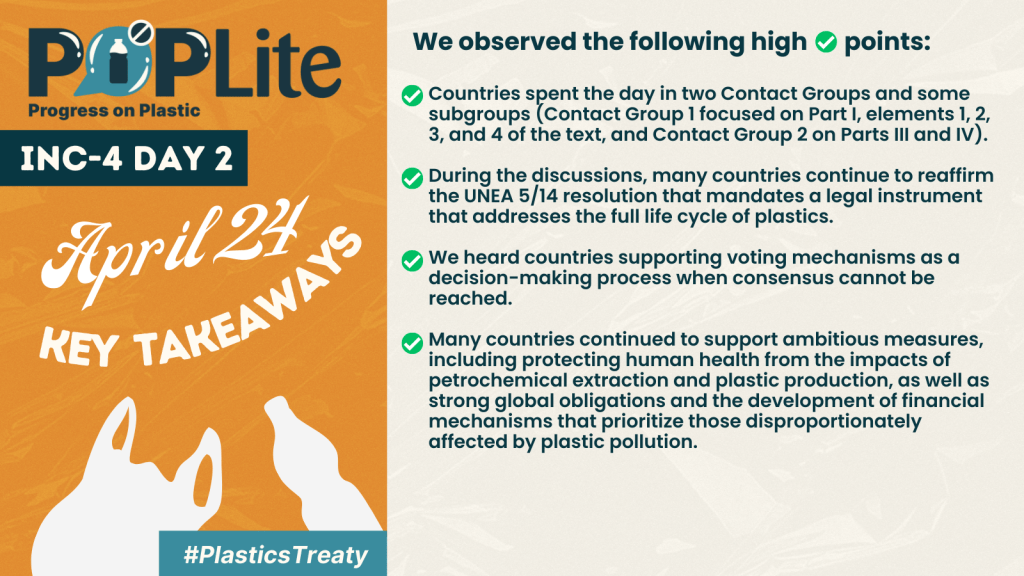
We observed the following high (✅) and low (✖) points:
✅Countries spent the day in two Contact Groups and some subgroups (Contact Group 1 focused on Part I, elements 1, 2, 3, & 4 of the text, & Contact Group 2 on Parts III and IV).
✅ During the discussions, many countries continue to reaffirm the UNEA 5/14 resolution that mandates a legal instrument that addresses the full life cycle of plastics.
✅We heard countries supporting voting mechanisms as a decision-making process when consensus cannot be reached.
✅ Many countries continued to support ambitious measures, including protecting human health from the impacts of petrochemical extraction & plastic production, as well as strong global obligations & the development of financial mechanisms that prioritize those disproportionately affected by plastic pollution.
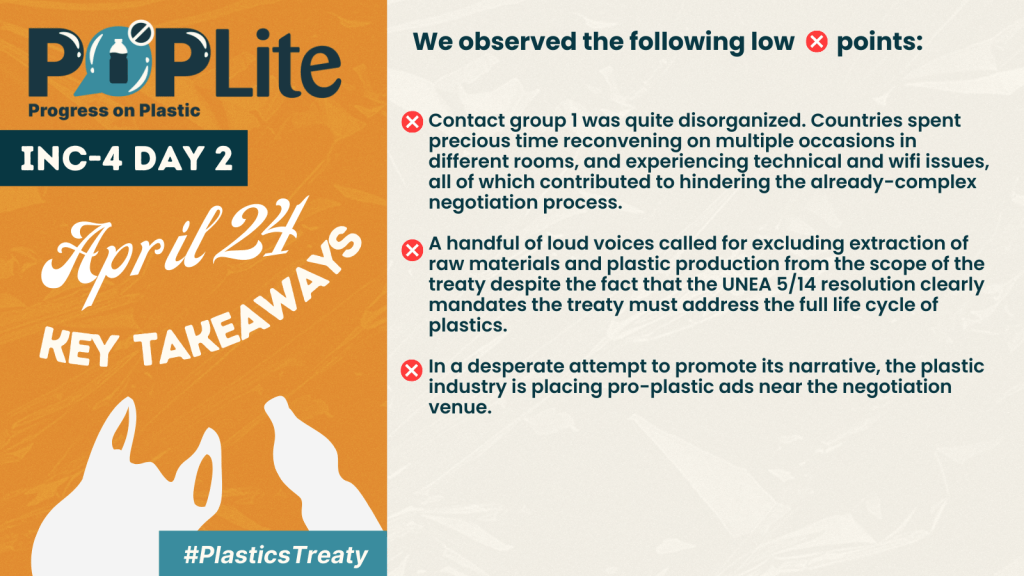
The low points:
✖ Contact group 1 was quite disorganized. Countries spent precious time reconvening on multiple occasions in different rooms, & experiencing technical and wifi issues, all of which contributed to hindering the already-complex negotiation process.
✖ A handful of loud voices called for excluding extraction of raw materials & plastic production from the scope of the treaty despite the fact that the UNEA 5/14 resolution clearly mandates the treaty must address the full life cycle of plastics.
✖ In a desperate attempt to promote its narrative, the plastic industry is placing pro-plastic ads near the negotiation venue.
Read: Global producer responsibility for plastic pollution
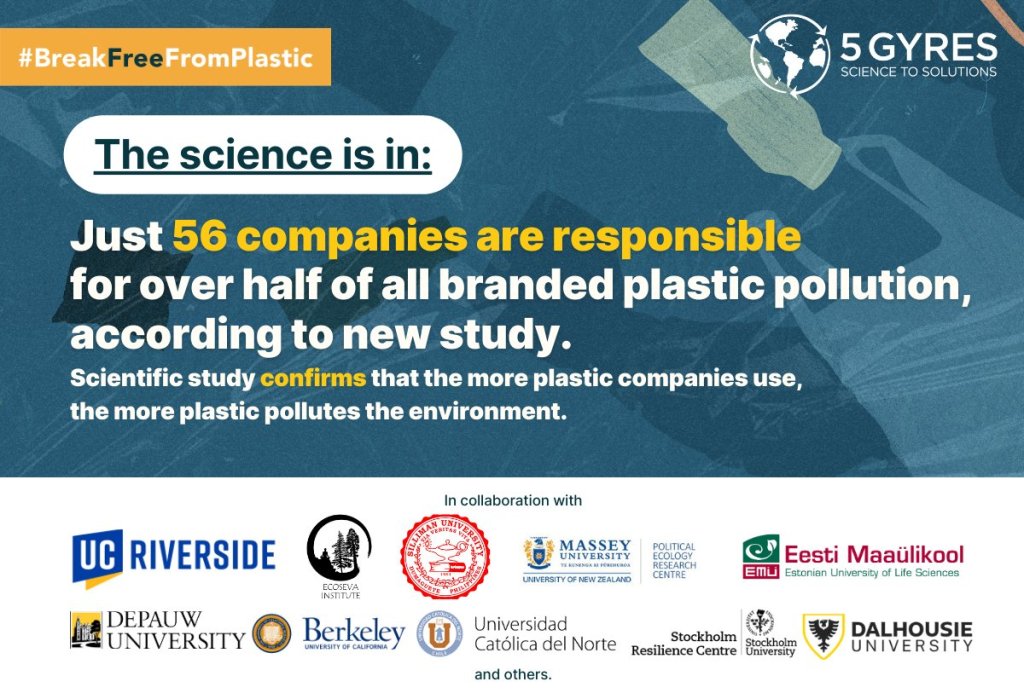
New Research confirms plastic production is directly linked to hashtag#plasticpollution. The study finds that more than half of global branded plastic pollution can be tracked to just 56 companies https://lnkd.in/dAXK2v9h
https://www.science.org/doi/10.1126/sciadv.adj8275
Spoiler of the Day: ExxonMobil
Today’s spoiler of the day goes to ExxonMobil and the International Council of Chemical Associations for their efforts to push back on curbing plastic production & downplaying the significance of plasticpollution in the media this week. Karen McKee, head of product solutions for ExxonMobil [and chair of the International Council of Chemical Associations]: “The issue is pollution. The issue is not plastic …A limit on plastic production will not serve us in terms of pollution and the environment.”
Exxon leads industry fight against UN plans to limit plastic, Financial Times, 22 April 2024. ExxonMobil’s vested interest in perpetuating plastic consumption hinders meaningful progress of the negotiations towards a Global hashtag#PlasticsTreaty.

For more information: https://lnkd.in/dSt-J4H6
Image Credit: Break Free From Plasti
 Waste Frames