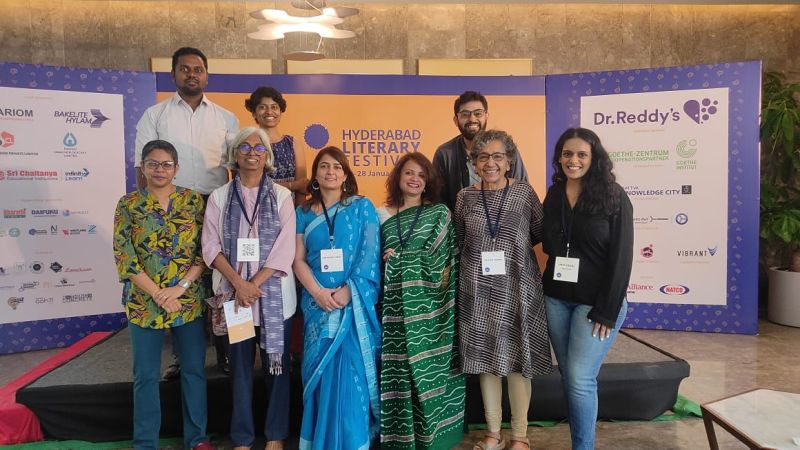
I was invited to the Hyderabad Literary Festival 2024, by EkoGalaxy, a startup that offers climate education and engagement. They curated a new & independent stream – Climate Conversations (CC) at the Festival.
The panel that I was invited to be a part of was titled My city’s waste: Where does it go?. And this was moderated by Priyanka Singh from CEEW India.
My co-panelists included Wilma Rodriguez, the founder and CEO of Saahas Zero Waste (SZW), a social enterprise committed to implementing holistic zero-waste solutions across India and Kalpana Sharma, independent journalist, columnist, and author specialising in developmental, environmental, and gender issues. She is the author of the must read book Rediscovering Dharavi: Stories From Asia’s Largest Slum.
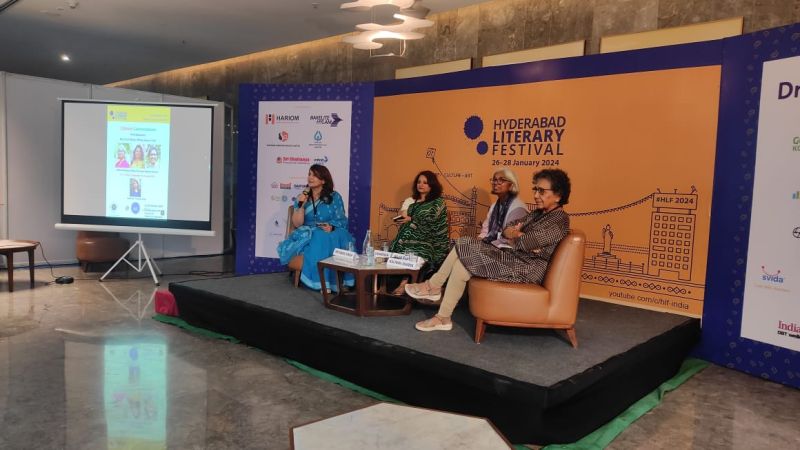
Priyanka started the panel with an audience quiz and then asked me a question, “As a poet and blogger, how can artistic expression contribute to raising awareness about waste issues?”
I replied with a poem, titled “What if your trash could talk?” that I had penned in 2016, before proceeding:
What if your trash could talk?
From the worn out sneakers that ran marathon,
To the tubes that held lavender infused body wash,
From the empty bottles of alcohol that tell tales of midnight woes,
To the printer, that wouldn’t print any love stories,
From the strings that could not tie,
To the mirror that broke hearts,
From the clock that could not heal,
To the chocolate wrappers that could no longer aid sinful pursuits,
But what about your mattress, your favourite dress, the special toy,
Does one ever pause to wonder
Of the journey of your trash?
A crisis is brewing,and it goes beyond the problem of waste, for everything is connected- air, water, soil. Is all lost then? Not at all
Have you ever wondered?
What is waste?
How is it wasted
And who works with waste and why?
-Pinky Chandran July 2016
And went to say that Garbage speaks to me, through poems. It allows me to reflect not just on what I buy, recycle, trash.It allows me to make sense of waste,
It allows me to understand, why do we feel repulsed? Why do we resist? Why do we refuse? Why is my clean not your clean? Why is garbage cloaked in a layer of anonymity and invisibility? Why do we see what we want to see? It also allows me to look at the city’s landscape , and our relationship with waste and people who work in waste. While everyone takes action in their own setting or context, poetry for me has a promise for engaging in waste activism. But then, as someone said, “Artists have an important role in society and it is the artists who reveal the society”.
She then proceeded to ask Wilma on the role of social enterprises and Kaplna on the role of media in reporting on issues of waste.
From then on, I loved how the discussions focused on people who work in and with waste. We discussed a range of issues around visibility and invisibility, caste, decent livelihoods, and livelihoods without exploitation, the use of people centred language over identity based language , and much more.
At the end of our discussions, one of the members from the audience stood up and said, ” We are really never going to achieve anything till we reduce plastic production”.
 Waste Frames