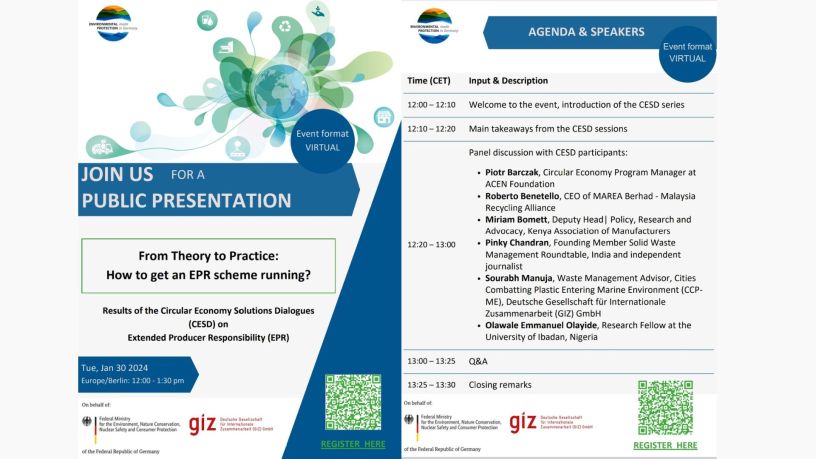
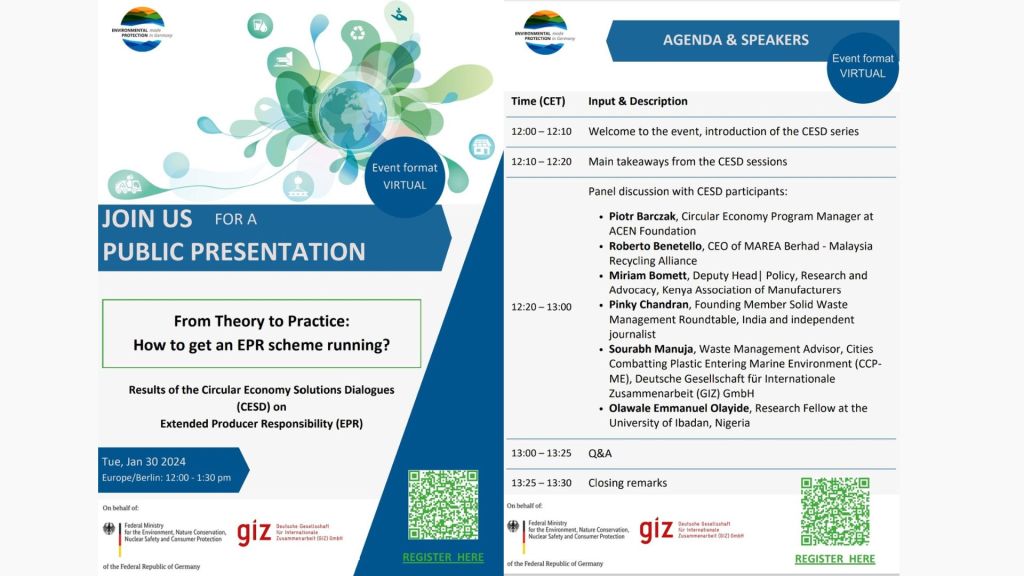
I was recently invited to speak on the topic “What prevents us from going from theory to practice when it comes to EPR implementation?”
We know that the rationale behind EPR is that traditional approaches can no longer manage the ever increasing post consumer waste and so this requires producers to pay for the environmental costs of these products (including recycling and disposal). But the most important aspect that underpins the policy principle of EPR, is that it will incentivise producers to reduce impacts of these products and encourage companies to redesign products for reuse and recyclability rather than disposing of them.
- Lack of vision
- The first thing that comes to my mind is lack of vision. What do countries really want from EPR? Is it for better public health?
- Is it waste reduction or diversion or recovery? In theory, the most important aspect that underpins the policy principle of EPR, is that it will hold producers accountable to internalise the full cost of their products thereby encouraging them to reduce impacts of these products and consider redesign for lesser pollution, reuse and recyclability rather than disposal.
- Is it to make money? Yes you heard it right. In August 2023, the media had reported that ‘BBMP, which is the municipality in Bangalore to implement EPR policy, aims to earn ₹100 crore annually. Disclaimer: Earning extra revenue is an aspiration that most municipalities chase, and there is nothing wrong in it. However, the question is do they truly understand what Extended Producers Responsibility means?
- Or Is the vision just financial aid for waste management? If yes, then what is the amount they are looking at? How have they arrived at the numbers? Where are the calculations, if any? When budgets for waste management are made, how are they allocated based on the provisions of zero waste hierarchy? Do countries have strict targets for landfill and incineration prevention? How can then EPR fit the shortfall and for what aspect?
2. Polluter pay principle not operationalised
In most countries, waste management rules do iterate the principles of waste hierarchy, which is reduce, reuse and recycle. However these terms continue to remain on paper
so, while on one hand we have producers that continue to design, manufacture, and sell products that cannot be recycled or as they are popularly called “technically recyclable”. All these then place heavy reliance on landfills and incinerators. And this leads to a vicious cycle – immunity to continue producing, without a care.
At first sight, the Polluter Pays Principle looks straightforward: if you pollute, you bear the costs of your pollution or to ensure that in every case where the environment is going to be polluted, the accountable industry bears the costs of cleaning up or preventing pollution including ensuring reparation for frontline/fenceline communities who are affected by the production, use and disposal of their products
When it comes to practical implementation, we have never defined
- What is considered pollution- existing plastics waste?garbage dumps/black spots? Litter? Waste from households? Industrial discard and emissions from producers? Incineration ash? Microplastics in our food, water and soil?
- Who should be responsible for the environmental and human health impacts of air, water, land pollution? The problem is we have never agreed upon the definition of the “polluter”.
- While many municipalities have laws around littering, – we have never really looked at liability that takes into account all the actual (social and ecological) costs of producing materials, including the impacts on health, climate, biodiversity, across the lifecycle.
- In the case of plastics is it just the PIBOs or do we fix accountability to the petrochem industries as well? How will this amount be calculated? I think here it’s important to emphasise that the true cost of impact across the plastic life cycle can never be fully accounted for – as much as economists would like us to believe. Even the plastic credit system (which is increasingly being implemented as a policy package with EPR) looks at the tonnage of waste “recovered” or “recycled” and probably quantifies emissions saved but what about environmental and social justice? Providing them homes made of eco plastic bricks is not justice. it is pushing them further down into pollution.
- Is it fair to pass on all the costs to consumers?
- Interestingly, in India, National Green Tribunal (NGT) has imposed Rs.4000 crore compensation on Bihar and other state governments on polluter pays principle for its failure in scientifically managing solid and liquid waste
3. Lack of research/data
- There is inconsistent, incomplete, unreliable and contradictory data on waste generated. ( It is not current)
- Most countries do not have accurate estimates or national level databases on waste pickers and other informal waste workers.
- Contributions made by the informal recycling sector – in terms of reduction of waste management costs for the municipality and the waste diverted from landfills – are largely unaccounted for (Scheinberg, 2012) and so planning for their integration tends to underestimate the scale of need, proposing solutions that do not match existing workers’ capacities.
- Data availability on the recycling landscape (including formal and informal systems, enterprise structures, labour relationships and challenges), especially in developing countries, is limited.
- Then most EPR frameworks also recommend establishing recycling infrastructure or collection points, without mapping existing recycling infrastructure in formal, informal or private spaces, resulting in poor investment planning and marginalising the existing informal waste sector. Again these are not tracked. Some areas may receive more infrastructure, resulting in under utilisation of existing infrastructure
- Action plans or statements by companies do not get tracked, so what gets reported is also not clear. Statements like we have Recycled 100% of Plastic sold as Product Packaging in India, are so vague and misleading. Recognizing this, the European Commission is developing a method to verify the percentage of recycled content to prevent such greenwashing. What kind of plastic packaging do you use? What are the numbers? Who did you collect them from? Did you ensure the supply chains were paid adequately? Were 100%recycled, and where? Or was it incinerated, as it was technically recyclable? Or did you end up making plastic benches or MLP boards? So when companies say the collected plastic waste is being sent to different Recyclers, Waste-to-Energy Plants and Cement Kilns, how is it 100% recycled?
- What was the recycling rate of each jurisdiction prior to the implementation of EPR? – Just saying that implementation of EPR has contributed to increased recycling is incorrect.
- Failure to include all stakeholders in the planning process – Identification of stakeholders is incomplete
4. Fragmented, and uncoordinated policy frameworks.
- If you have a target of reuse? Do we have guidelines on the operationalising the same? Are there other enabling policy support created? Are we investing in reuse systems even 10% as we are in petrochemicals or refuse derived fuel or even RE?
- Do you ensure that failed pilots gets reported?
- Do you include all relevant sectors within EPR framework – A case point is that we are now talking about textiles
In conclusion, if we look at EPR in a linear, piecemeal approach then we are never going to be able to turn into a reality. We have to plug in gaps, identify all stakeholders, craft our vision, and get to work. Data tracking, transparency is the key here. At the same, punitive measures for non complaince must be strictly enforced.
####
Acknowledgement: Special thanks to Arpita Bhagat, GAIA Asia Packific, for her critical inputs
 Waste Frames